Free solar panels in 11 states? What the ads really sell (2026)
There is no government program giving homeowners free solar panels in 11 (or 12) states. What the ads actually offer, and the real no-cost programs in 2026.
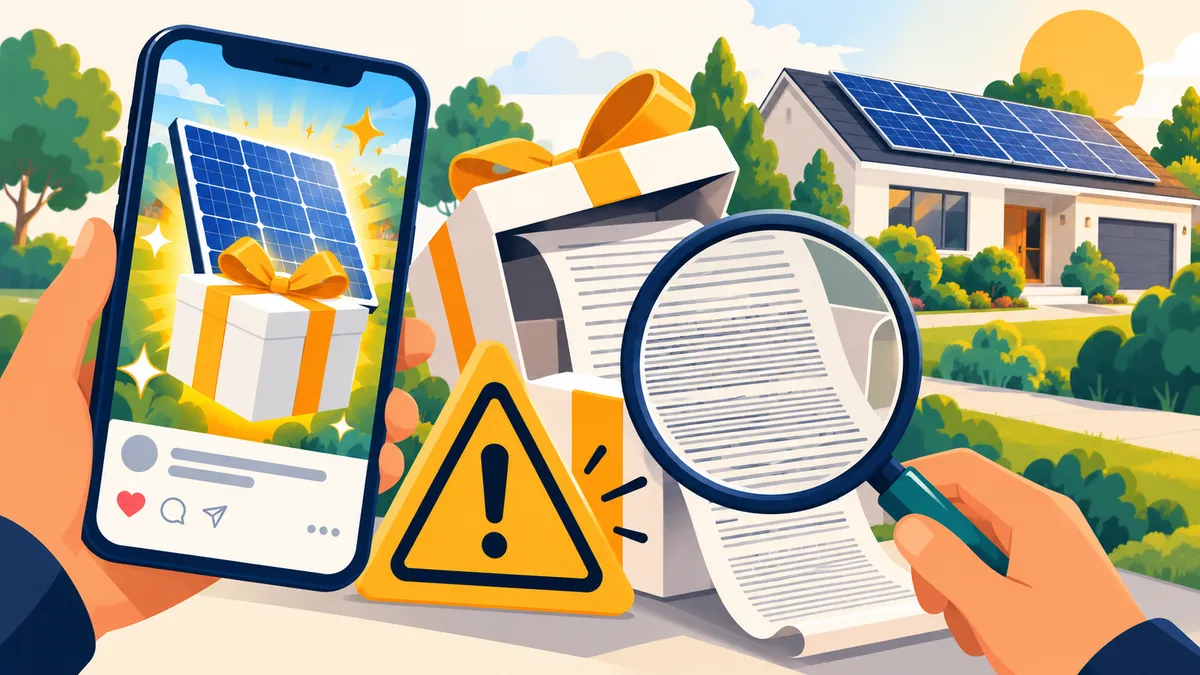
No state gives homeowners free solar panels, and there is no “11 states” or “12 states” government program. The ads that say so are almost always collecting your contact details to sell to solar companies, and the “free” system they lead to is usually a lease or power purchase agreement: $0 upfront, then a monthly payment for 20 to 25 years. A handful of real programs do install solar at no cost, but they’re limited to income-qualified households in specific places.
If you clicked an ad promising free panels “if you live in one of these 11 states,” here’s what’s actually behind it, and what’s real.
Where the “11 states” ads come from
The script is familiar: a video or social post says a new “solar stimulus program” or a law in certain states lets homeowners get panels installed for nothing. You enter your ZIP code to “check eligibility,” then your phone starts ringing.
These are lead-generation ads. The page collects your name, address, and phone number and sells them to installers or sales companies. There’s no published list of states behind them that we could trace, because the list isn’t the point. Any state where solar companies buy leads can appear in the ad. We’re not going to reprint the lists circulating online, since none of them describes a real program.
The fact-checkers and regulators have been saying this for years:
- PolitiFact rated a viral video about a “solar stimulus program” that supposedly required companies to give away panels as False in April 2023, noting that “free solar” offers are usually leases.
- The FTC warned in September 2024 that going solar isn’t free, and that sellers who claim a government program will cover the whole cost or who claim to be affiliated with the government are a warning sign.
- The Better Business Bureau describes a “(non-existent) government program” pitch that ends with a request for bank details “to see if you qualify.”
- California’s Contractors State License Board called out flyers in 2023 that claimed a state law required solar to be installed with no out-of-pocket cost. The law they cited does no such thing.
State attorneys general from Georgia to Washington, D.C. have issued similar warnings, often about callers pretending to represent the local utility.
What “free solar” usually turns out to be
When the call comes, the offer is real enough. It’s just not free. It’s almost always one of two contracts:
A solar lease. A company installs and owns the panels. You pay a fixed monthly amount for 20 to 25 years, often with an annual increase built in.
A power purchase agreement (PPA). Same ownership, but you pay for each kWh the panels produce, usually at a rate below your utility’s, again often with an escalator.
Neither is a scam on its own. A fair lease or PPA can lower your electricity costs from day one with nothing down. In 2026 they’ve even become more common, because the company that owns the panels can still claim a commercial federal tax credit that homeowners lost at the end of 2025 (the federal solar tax credit guide explains how). But “$0 down” is not “$0,” and the details decide whether you save money:
| Contract term | What to look for |
|---|---|
| Escalator | 2.9% a year roughly doubles your payment by year 25. Zero or 1% is far better. |
| Starting rate | Compare the price per kWh to your current utility rate, not to a projected future rate. |
| Term | 20 to 25 years is typical. Ask what happens at the end. |
| Home sale | The buyer has to qualify to take over the contract, or you pay it off. |
| Buyout | Get the buyout price schedule in writing. |
| Liens | Ask whether the company files a UCC fixture filing on your home. |
The loan vs lease vs cash guide compares the total cost of each path over 25 years.
The signs you’re being worked, not informed
You can usually tell within a minute of the call:
- They say they’re from the government, a state program, or your utility. Utilities don’t cold-call to sell rooftop solar, and Duke Energy, for example, doesn’t sell panels at all.
- They ask for your utility account number, bank details, or Social Security number before you’ve seen a written proposal.
- They mention a “30% tax credit” on a system you’d own in 2026. That credit ended for installations completed after December 31, 2025.
- The offer “expires today,” or they want a signature on a tablet during the first visit.
- Nobody can tell you the escalator, the term, or the buyout price.
If you’ve already signed, you likely have a cancellation window. The FTC’s Cooling-Off Rule gives three business days for most in-home sales, and some states give more (Texas allows five business days for residential solar). The solar panel buying guide covers how to cancel and what a legitimate quote looks like.
Real no-cost and low-cost solar programs in 2026
Here’s the honest part the ads distort: a few programs do put solar on homes at no cost. Every one of them is aimed at lower-income households, has eligibility rules, and runs on a limited budget.
California: DAC-SASH. The Disadvantaged Communities Single-family Solar Homes program offers no-cost rooftop solar to low-income homeowners (those enrolled in CARE or FERA utility discounts) who live in the state’s most disadvantaged communities, as identified by CalEnviroScreen. It’s administered by the nonprofit GRID Alternatives with a budget of about $10 million a year through 2030. Since July 2025, GRID itself owns the systems after the previous third-party owner withdrew.
Illinois: Illinois Solar for All. A state program (separate from the federal grants below) run by the Illinois Power Agency. It offers rooftop solar with no upfront cost for households at or below 80% of area median income. Demand is high and slots for each program year can fill, so ask an approved vendor about the waitlist.
New York: Statewide Solar for All. Not panels on your roof, but free bill credits from community solar, applied automatically for customers enrolled in their utility’s energy assistance program.
New Jersey and other community solar states. New Jersey’s community solar program reserves most subscriptions for low- and moderate-income households, which get a discount on their bill without installing anything.
Washington, D.C.: Solar for All. A local program that has installed no-cost rooftop systems for income-qualified homeowners since 2016. Its planned expansion depended on federal funds that are now in question, so check with DC’s Department of Energy and Environment directly.
What happened to the federal Solar for All money
In 2024, EPA awarded $7 billion in Solar for All grants to states, tribes, and nonprofits, and some “free solar” pitches still cite it. EPA moved to terminate the grants on August 7, 2025. In September 2026, two federal courts (in Rhode Island and Washington, D.C.) ruled the termination unlawful, but neither ruling immediately restarted payments, and EPA was weighing an appeal as of mid-October 2026. Several state programs funded by those grants were on hold, including Washington’s (and, by public reports, Colorado’s). Bottom line: if someone tells you federal Solar for All money is paying for your panels today, verify it with your state energy office before you sign anything.
If your household income is low, the place to start is your state energy office or a nonprofit like GRID Alternatives, not an ad. The federal Weatherization Assistance Program is also worth a call: it mainly funds insulation and efficiency upgrades, not free panels, but it can lower your bill without a contract.
If you’re not income-qualified: what actually lowers the cost
For most homeowners, there’s no free route, but there are honest ways to pay less:
- Get three itemized quotes and compare the price per watt. In 2026, cash quotes between roughly $2.50 and $3.40 per watt are normal for a home without a battery.
- Check your state and utility incentives. Some are significant, such as New York’s 25% state tax credit (up to $5,000) or Duke Energy’s PowerPair rebate in North Carolina, while it lasts. Start with solar incentives by state.
- Size to your usage, especially if your utility pays little for exported power.
- Run your own numbers first. The solar savings calculator needs only your monthly bill and state, asks for no contact details, and shows the payback without any phantom credit.
If you see the “11 states” ad again, the useful response is to close it. And if someone has already called you claiming to be from a government solar program, report it to the FTC at ReportFraud.ftc.gov and to your state attorney general.
Estimate your own solar payback
Three inputs. Real local rates. An honest 2026 estimate.
Fine-tune (orientation, offset, financing)
In California, a ~3.4 kW system could pay back in ~9.1 years.
- System size
- 3.4 kW
- Est. net cost
- $9,922
- Annual savings
- $1,087
- 25-yr savings
- $29,619
Loan payment: —
Your state’s rules & the 2026 credit
Net metering: Select your state.
Incentives: Select your state.
The 30% federal residential solar tax credit (IRC §25D) expired on December 31, 2025. Homeowners who buy a system in 2026 do not receive a federal tax credit. Leasing or a PPA (third-party ownership) may still pass through some federal benefit via the commercial credit, which requires construction started by July 4, 2026 or service by Dec 31, 2027 — always verify current federal and state incentives before signing.
Estimated annual production: —; gross cost —; panel count —.
Estimates only — not financial advice, and no federal credit applies to 2026 purchases. Your real numbers depend on roof, usage, utility, equipment, and quotes — verify and get itemized bids.
Sources & methodology
Figures are estimates built from these primary sources. We re-check them as rates and policy change — see our editorial policy.
- FTC — Solar energy is rising in popularity. So are the scams (Sept 2024)
- PolitiFact — No, solar companies are not required to give away solar panels (Apr 2023)
- BBB — Scam alert: free solar panels can cost you big time
- California CSLB — warning on illegal 'free solar' advertisements (Apr 2023)
- CPUC — Solar in disadvantaged communities (DAC-SASH)
- Illinois Power Agency — Illinois Shines / Illinois Solar for All factsheet
- Columbia Law School Climate Law Blog — courts on EPA's Solar for All termination (Oct 2026)
Frequently asked questions
Which 11 states give free solar panels?
None. No federal or state program gives homeowners free solar panels in 11, 12, or any set number of states. The ads that say so are usually lead-generation funnels for leases or power purchase agreements, which cost $0 upfront but come with a 20 to 25 year monthly payment. A few real programs do install solar at no cost, but only for income-qualified households in specific areas.
Is the 'solar stimulus program' real?
No. PolitiFact rated claims about a solar stimulus program that requires companies to give away panels as false, and the FTC warns that going solar is never free and that sellers claiming government affiliation are a red flag. The federal homeowner solar credit actually ended for systems installed after December 31, 2025.
What does a $0-down solar offer actually cost?
A $0-down offer is usually a lease or PPA: a company owns the panels on your roof and charges you a monthly payment or a price per kWh, often with an annual escalator of 1% to 3% for 20 to 25 years. It can still save money, but you pay for the system over time, and the contract can complicate selling your home.
Are there any real free solar programs in 2026?
A few, all income-qualified. California's DAC-SASH program installs no-cost solar for low-income homeowners in designated disadvantaged communities, and Illinois Solar for All offers no-upfront-cost rooftop solar for households at or below 80% of area median income. New York's Solar for All gives bill credits from community solar rather than rooftop panels. The federal EPA Solar for All grants were terminated in 2025 and remain tied up in court.
How do I report a free solar scam?
Report it to the FTC at ReportFraud.ftc.gov and to your state attorney general's consumer protection office. If the caller claimed to represent your utility, tell the utility too. Never share bank details or a utility account number with someone who contacted you first about a free solar program.